
Why the climate movement is failing
Part 1: Dumbed down, divorced from conservation, and ignoring obvious and actionable solutions

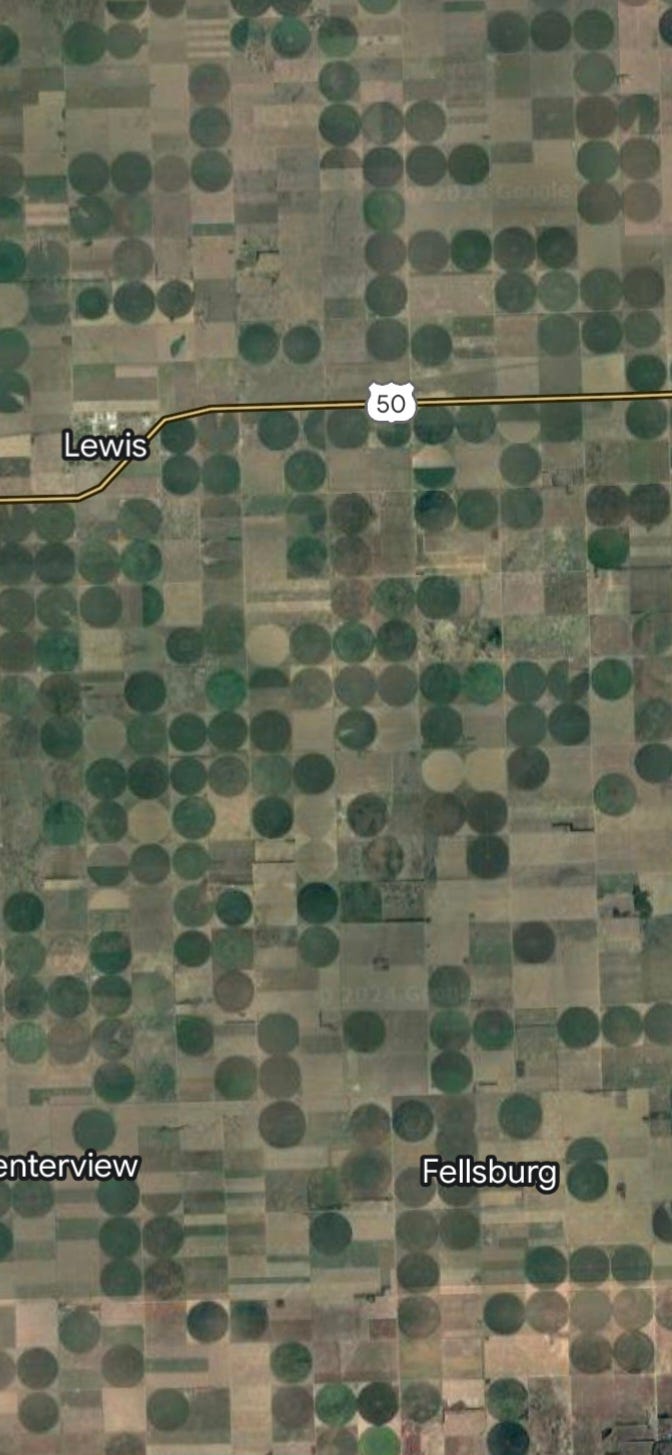
I rarely travel these days, and the only way I see the wider world is the satellite view on Google maps, where I can fly anywhere like a witch on a broom, zooming in to check details and doing some creeping here and there on street view. It’s a good way to see places I will never travel to in real life, but it has second and more useful aspect: It allows me to observe the ways humans have impacted the land.
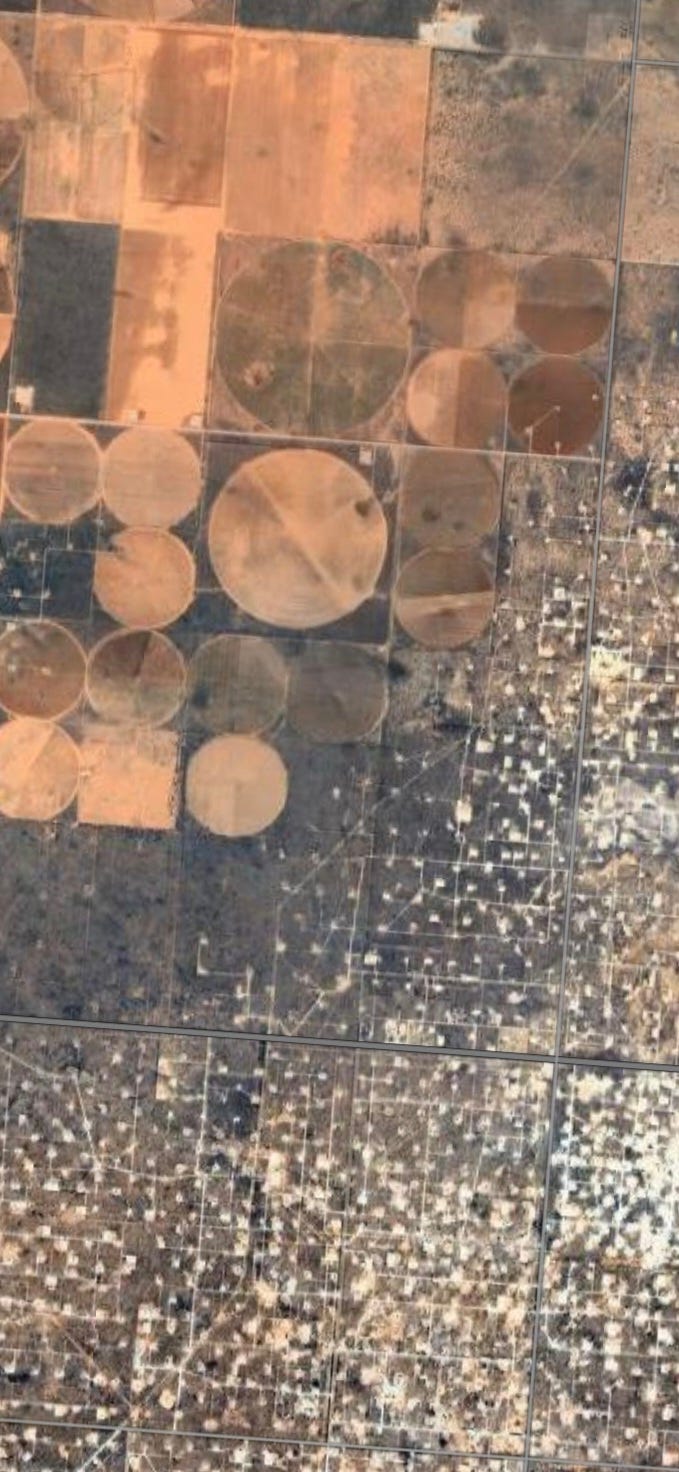
If you don't have occasion to fly across the US, I recommend taking a virtual trip across the United States (or your country of residence.) In the US, you will see coastal plains and river valleys choked with human-built structures, and sprawling expanses of monotonous suburbs. In the middle of the country you will notice unnatural patterns of squares and circles, the latter the result of center point irrigation set ups. You might know, as I do, that there is very little wild land left, but to actually view the country this way gives new insight into what has been lost.
Cross-country road trips don’t provide the same perspective. Looking out a car window during growing season, under blue skies and surrounded by lush vegetation, things don’t seem so bad. Viewed from above, the extent of human influence is much more noticeable, and the comforting, bucolic green of ground-level corn and soybean fields is revealed as a repeating pattern covering vast expanses. Sailing over the landscapes of Iowa and Nebraska, Texas and Oklahoma, Kansas and eastern Colorado, provides images of land nearly wholly tamed.
Taking into consideration that people need to be fed, this intensive cultivation might be the best possible use of the land, but I doubt it. On a drive through flyover country, I might be able to sustain this belief, but witnessing the endlessly repeating artificial patterns from above belies it. It looks like what it is: a vast, artificial wasteland of extraction for profit, under the guise of feeding the world. That there are beautiful places remaining in the region with inviting towns and good people, doesn’t change this fact.
When I view the American interior from above, I imagine what used to be. An enormous aggregation of life, and the water which that life held in place, has simply been removed. Before all those circles and squares appeared there was something else there, something that reached deeper into the soil and much higher above ground than the height of corn and wheat. It was astoundingly intricate, and it softened floods and droughts, regulated weather, and stored carbon.
The fact that we don't connect this almost incomprehensible change in the land to a corresponding change in weather patterns and climate is astonishing. Of course, some do connect it: Many understand that an enormous amount of carbon was set loose in the atmosphere when the life existing above and below ground was disturbed. But our obsession with this atmospheric CO² is lopsided. We are intensely focused on how it functions in its current location, while rarely acknowledging its role when it made up life.
The word “unalive” has popped up recently as a way to avoid algorithmic censorship, a reason I understand, but one that doesn't prevent the term from sounding silly. However, it describes perfectly what happened to the molecules that made up the ecosystems of the continent that were destroyed over the last centuries. When we killed off grasslands and forests and their associated life, we unalived the carbon held in these living things. Now we focus almost entirely on how this carbon functions as an atmospheric gas, with little regard for what it once did when it comprised living creatures.
Before the Great Unaliving, the carbon cycled, and by cycling regulated systems. It fostered greater complexity over time, eventually reaching relative stability. In its living form it held water in soil and plants and released it slowly over time, softening temperature extremes, and mitigating floods and droughts. It helped to bring rain by releasing aerosols that encouraged cloud formation, and these clouds both cooled the land and insulated it. It coalesced in the bodies of beaver who engineered systems to sequester water, and in bison who turned plant matter into rich fertilizer, begetting more life. Now this carbon, which in its living form regulated climate, has been relocated to the atmosphere where it has not only been turned into a problem, but is the sole focus of our so-called solutions.
The best propaganda contains facts, but only carefully curated ones. Atmospheric CO² does indeed act as a greenhouse gas, but it is only half of the story. Among those who recognize the effect that life and its removal have on the climate, there have been various hypotheses put forth as to why in climate science the emphasis came to be placed wholly on atmospheric greenhouse gases. One explanation is that it is too difficult to quantify the role of living systems in regulating climate. Modeling climate scenarios based on differing GHG levels is easier.
Whatever the reason for this development — and difficulty of study seems a ridiculous excuse to me — it has greatly influenced people's perceptions of the problems we face. Since the focus of research tilts heavily towards atmospheric CO² and other gases, media coverage and solutions that focus on the same naturally dominate. The climate change story commonly told is simple and linear: Humans burn fossil fuels, carbon accumulates in the atmosphere, and this carbon is the main driver of global warming. This story isn't false as much as incomplete.
Biodiversity loss, on the other hand, is often reported in the media not as a driver of climate change, but as a consequence of heat waves or other extreme events resulting from rising GHG levels. Catastrophic die-offs are the focus rather than the inexorable destruction of habitat as forests are cleared and grasslands are plowed under and paved over. Because the general understanding is that the planet is warming due to an overabundance of atmospheric GHGs, and the main solution is reducing their concentration, people are therefore quite content to sacrifice biological systems if they think it will keep temperatures down.
The climate story has been dumbed down. Simplifying lessons when teaching complicated subject matter can be an effective strategy, especially with children, but reducing the story of climate change to an excess of GHGs has had ruinous effects on attempts to solve humanity’s climate problems. Actionable solutions such as restoration of land into functioning ecosystems and bringing water back to drying lands are ignored. In fact, it’s worse than that. In the name of reducing fossil fuel use, natural systems are destroyed. Forests are cut and burned to generate electricity; mines that extract minerals necessary for “renewable energy” gouge out vast expanses of the biosphere.
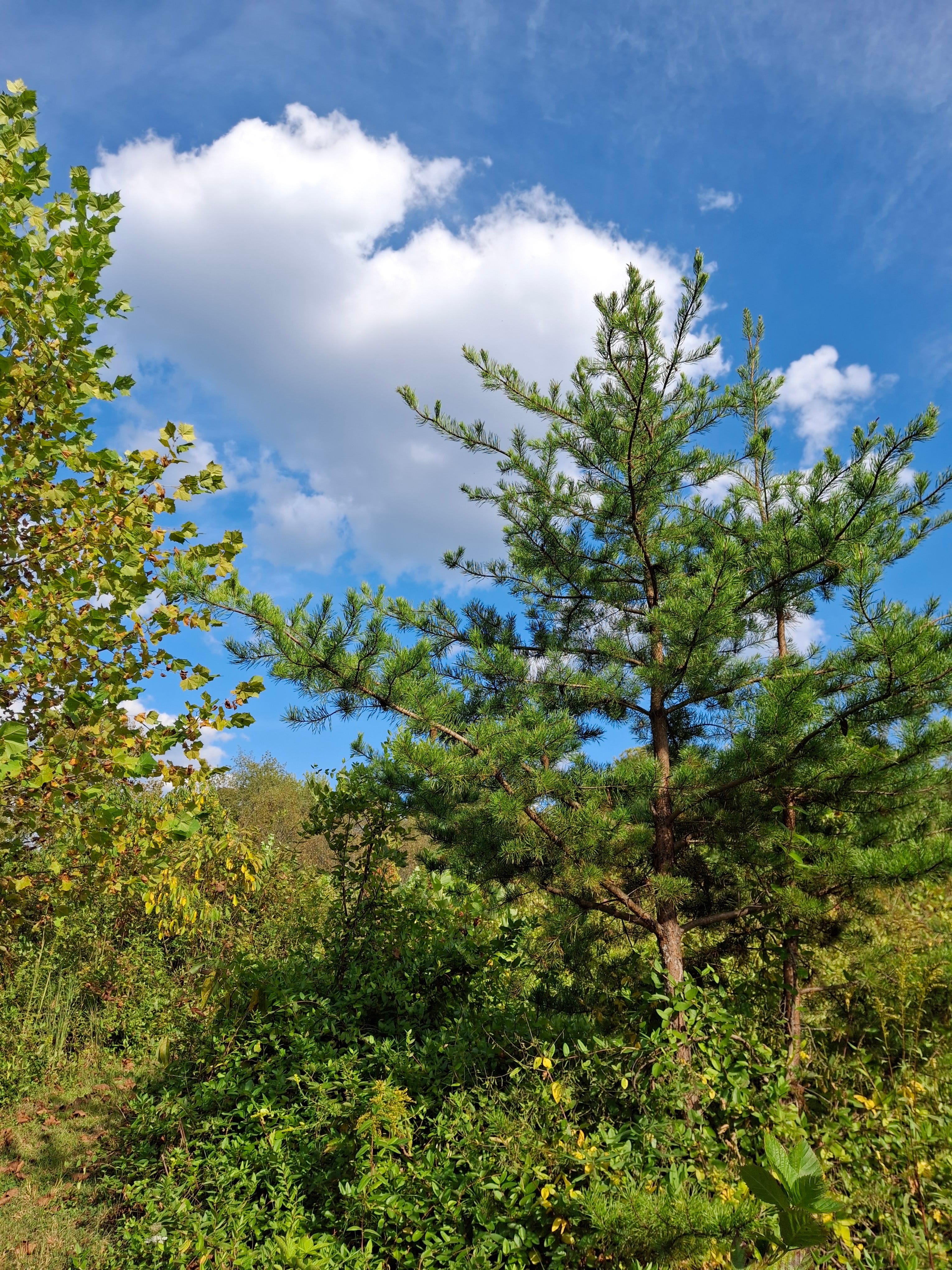
The dumbing down of our understanding of climate change mirrors that of politics in general. Listening to political commentary, you would be forgiven if you assumed that there exists no political landscape outside of Republican and Democrat territories. Climate change rhetoric is no different. You can believe either that anthropogenic climate change is a hoax or or that evil oil company executives have conspired to keep us hooked on fossil fuels, and the resulting GHGs are the worst problem we face. It is more important to pick a side and recite its doctrine unquestioningly in order to demonstrate loyalty than it is to seek solutions.
The environmental crisis has been simplified to the point of distortion. There is a whole suite of possible initiatives to heal earth and climate involving living systems that we're not reading about or discussing. Not only are we ignoring solutions, we are actively sabotaging them through further environmental destruction in the name of alternative energy. It is absolutely no wonder that that climate movement is failing. It will continue to be an exercise in futility until it is reunited with traditional conservation, and there is acknowledgement that the problem is more complex than an excess of carbon in the atmosphere.
Coming soon, Part 2: The Climate Echochamber
I had a chat with some climate alarmists this week and the level of ignorance was astounding. I asked them for the primary publication relied upon by the IPCC for them to claim that CO2 retains heat and is responsible for an allegedly warming climate. There was no response (because it doesn't exist). I informed them that the environmental movement was hijacked by Edmund de Rothschild and his UN, oil tycoon lackey, Maurice Strong, when Mr.Rothschild gave instructions to world leaders at the 1987 world wilderness conference when George Hunt, a whistle blower, exposed the globalists plans to dominate the world through 'Green' policy!
This of course led to the UN sustainable development goals, the blueprint for totalitarianism; essentially, a modern rewrite of Karl Marx manifesto! I also mentioned how climate alarmists should me up in arms about the mass poisoning of our stratosphere with weather modification technologies such as stratosphere aerosol injection and solar radiation management. I explained that the same governments who are claiming that 'climate change' is caused by pollution, are using pollution to 'mitigate' climate change!!! I was met with more blank stares!
I explained how the real problems we face are mass chemical poisoning and land misuse, all a result of the anti human religion of Statism! In other words, the root cause of all our problems is illegitimate governance; a subject I cover extensively in my work on Substack and YouTube.
An excellent article Lynn Cady. We should be looking at the Earth beneath our feet and the life it supports and rebuilding that wonderful complexity rather than just staring at the skies and waiting for a techno fix to sort it all out.